Sunday, November 12, 2006

The Science of God

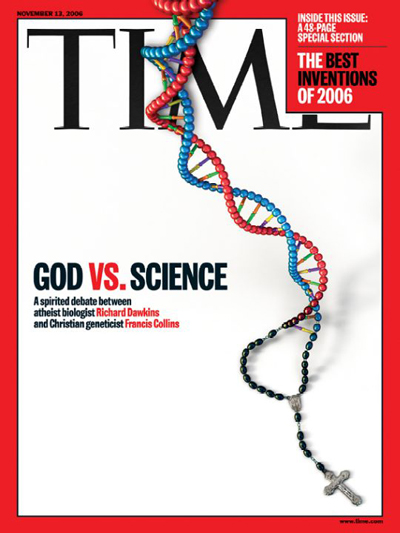
Richard Dawkins is an eminent British ethologist, evolutionary scientist, popular science writer and an outspoken Atheist. His recent book, The God Delusion, has generated a lot of controversy because of its harsh criticism of religion and faith. In Time magazine his debate with Christian Physicist Francis S. Collins is the subject of the cover story of the November 13th, 2006 issue.

I am always puzzled by how any intelligent person, particularly a scientist, can claim to be an atheist.

Atheism;
(noun) - the belief that God does not exist.

For someone to claim to be an atheist is to say that they believe that God does NOT EXIST. This does not seem to make any logical sense. This is equivalent of confessing to believe that hippos are not pink - it is a redundant belief - in essence a double negative. If something really does not exist , it seems to be meaningless, or at least pointless, to even discuss that you don't believe in it! What a tremendous waste of time.

I don't think that this is really what most so-called atheists mean when they say that they don't believe that God exists.

During the debate Dawkins makes this interesting point:

“My mind is open to the most wonderful range of future possibilities, which I cannot even dream about, nor can you, nor can anybody else. What I am skeptical about is the idea that whatever wonderful revelation does come in the science of the future, it will turn out to be one of the particular historical religions that people happen to have dreamed up. When we started out and we were talking about the origins of the universe and the physical constants, I provided what I thought were cogent arguments against a supernatural intelligent designer. But it does seem to me to be a worthy idea. Refutable--but nevertheless grand and big enough to be worthy of respect. I don't see the Olympian gods or Jesus coming down and dying on the Cross as worthy of that grandeur. They strike me as parochial. If there is a God, it's going to be a whole lot bigger and a whole lot more incomprehensible than anything that any theologian of any religion has ever proposed.”
- Richard Dawkins, "God Vs. Science," Time Magazine, November 13th, 2006

From his statement, it is obvious that the God that Dawkins doesn't believe in is the stereotypical God of superstition - you know, the "Man Upstairs," or the "Cosmic Policeman." The schizophrenic God of literal interpretation. (see my blog post on The Cult of Literalism.) I don't believe in that God either!!!

Often, when I read articles or books by atheists, I agree wholeheartedly with their arguments against the kind of God that is painfully represented by high profile TV evangelists and preachers. That's the kind of God that I rejected very early on in my life. When I looked at the complexity and great beauty of the creation I had to acknowledge that reality went much deeper than the simplistic view that seemed to be held by most religious people that I met. So, when I began my spiritual seeking over 40 years ago - I approached the search for truth from a viewpoint that was more like that of a sceptical scientist than that of a religious pilgrim.

FAITH IS A JOURNEY, NOT A DESTINATION

Richard Dawkins once publically made this statement about faith:

"Faith is the great cop-out, the great excuse to evade the need to think and evaluate evidence. Faith is belief in spite of, even perhaps because of, the lack of evidence." -From “The Nullifidian" (Dec 94)

Atheists seem to have the habit of coming up with a bad definition of something, like God, or faith, and then they spend considerable amounts of time proving it to be wrong!!!

A few years ago during a discussion with a very vocal Atheist, I asked him what evidence would inspire him to consider further investigation into the truth of Christianity, He thought for a moment and said - "I'd like to read an eyewitness account of a contemporary of Jesus who was not a believer - that would convince me." He really thought that he had come up with an impossible challenge but I responded with another question: "If you were an eyewitness of something that you observed to be true - wouldn't you be a little crazy not to believe it??"

He wasn't very happy about my response. I believe that in his case he was not someone who believed that God didn't exist - an Atheist, or even someone who didn't know if God exists - an Agnostic. He was simply like a lot of "unbelievers" - He didn't WANT TO KNOW if God exists.

Orthodox Christianity is a journey, not a destination.

Faith, to an Orthodox Christian is believing beyond the facts, in the same direction of the facts. It's this kind of faith that leads to an attitude of constant discovery of deeper levels or realities of the truth - not to an attitude where truth is possessed or becomes a closed opinion. One grows in faith by investigation - Jesus encouraged doubters to investigate (i.e. He invited St. Thomas to touch His side). Jesus did not expect blind faith from His followers.

This kind of faith is not too much different from the motivation that inspired one of Dawkin's heroes, Charles Darwin, to investigate and seek evidence for his theories for the origins of species. If Darwin had taken the attitude of unbelief in his theories due to insufficient evidence - perhaps Dawkin's destiny may have been different.

PROVISION FOR THE JOURNEY

“When you set out to seek the truth, one provision for the journey that’s very helpful is: Be sure you allow for accepting it when you find it."

- Happy Dodds, “Spiritual Being – A User’s Guide,” p. 83

Sunday, November 05, 2006

The Process of Spiritual Fitness


I would not join any club that would have someone like me for a member."
- Groucho Marx

Whenever I go to a health club I often feel intimidated and embarrassed because so many people there are obviously in better shape than me. Then one day someone pointed out to me that this was perhaps the best reason to keep going, because many of those people had been transformed by their discipline - they had started out in bad shape, but through devoted effort had become fit, strong and healthy. I should view them as examples and role models, a source of encouragement.

Attending a health club or exercise facility in its purest sense is about practicing a process of development and maintenance.

When it comes to Christianity, and in particular, the activities of the church, we seem to have similar, unrealistic or distorted expectations about those who call themselves Christians.

THE CONDEMNING HERD MENTALITY
I know many inside and outside the church who expect "church" people to be models of morality - close to spiritual perfection. When someone falls short or fails to live up to this impossible standard, a herd mentality prevails and the spirit of condemnation and rejection rears its ugly head.

UNFIT CHRISTIANS

One of the sad observations that many make about the church, and use as a reason for their lack of confidence in it, is that it is "full of sinners."

Ironically, "sinners" are the very people that the church should seek - they are the "sick" that are in need of a doctor - they are the "unfit" that can really use a "workout."

The real problem is not those that fall, as disappointing and sad as that is, but the distorted view of "sin" and "repentance" as understood in Cultural Christianity.

Some Recent Headlines:


"Pastor to resign from church amid sex scandal"

"Catholic priest gets maximum 7 years for child pornography"

There is a natural sense of moral outrage when we read about these scandals within the church. However, the mob response of calling for immediate condemnation or "excommunication" is also wrong, and does not demonstrate the compassionate kind of forgiveness that Jesus demonstrated and taught as appropriate for His followers. Jesus never condemned the sinners - it was always the unrepentant hypocrites.

'If we say we have no sin, we deceive ourselves, and the truth is not in us. If we confess our sins, he is faithful and just, and will forgive our sins and cleanse us from all unrighteousness. If we say we have not sinned, we make him a liar, and his word is not in us." - 1 John 1: 8-10

The Disease of Sin

When I was an Evangelical Protestant I was taught that my sin (in the sense of my behavior) was what separated me from God - this sounded so right, and lead me to the seemingly obvious conclusion that if I changed my behavior, I would be closer to God. However, I was also taught that it was impossible for me to stop sinning - so Jesus died to fulfill the requirements for my righteousness - therefore I was saved from my sin. The implication was that when I "accepted" Christ as my personal Savior, I was delivered from sin, and the desire to sin would decrease.

When I began to investigate Orthodoxy and joined the Eastern Orthodox Church I discovered that my understanding of sin and salvation was not complete.

The Orthodox Christian definition of "Sin" is that it is a disease that has corrupted our human nature - a kind of genetic defect in our DNA.

According to Orthodox teachings :

"Adam and Eve sinned when they disobeyed God in the Garden of Eden, thus introducing into mankind the disease of sin. This event, the Fall of Man, altered the dynamic state of humanity's existence, making him prone to sin, which is an ontological separation from God. Although it is now possible for human beings to choose not to sin, their tendency is toward it. The consequence of the Fall is the introduction of death to humanity; it is death--and the fear of it--which is seen to be the progenitor of man's sins. All mankind is thus in need of salvation, which is the process of restoring man to the pure state in which he was created and growing him even beyond that toward perfection. This process, termed theosis (Greek, "deification" or "divinization"), is eternal and is the continual deepening of communion between God and man, a unification without fusion of the human person with the divine persons.

The second person of the Trinity, the Son of God, thus became genuine man in order to accomplish salvation for humanity, which is incapable of doing so on its own. Eastern Orthodox theology teaches that when the Son of God became the man Jesus Christ, he took on human nature while keeping his divine nature. He is thus one person (hypostasis) with two natures. Orthodox soteriology is therefore aimed at the bringing of man by grace to become what Christ is by nature, that is, being holy. This process neither sacrifices monotheism nor the eternal distinction between the created and the uncreated, because it is eternal and there is no final arrival point.

Progress toward salvation is accomplished in the earthly life only by God's grace, with which man must freely cooperate. The free cooperation of man includes prayer, asceticism, participation in the sacraments, following the commandments of Christ, and above all, repentance of sin. Salvation is thus for the whole human person, involving both the body and the soul." (From Wikipedia )

Sin is what causes us to behave badly - it is not just the behavior itself. This is why Jesus said that to commit adultery in the heart was the same as actually doing it. Therefore in Orthodoxy one sinful behavior is not ultimately worse than another - all are indicative of the corrupted nature of mortality, and differ only in the levels of impact that they have on others. All sinful behavior is contrary to God's will. This principle is illustrated in Jesus' sermon in Matthew 5, where He contrasts the "Letter" of the law with the "Spirit" of the law - exposing a common mental attitude or heart condition that underlies all evil actions.

The emphasis in the practice of Orthodox Christianity is not the classification of various levels of sin but rather the transformation of the attitude of the heart and mind that ultimately CAUSES us to sin. Therefore, all of us sin and are capable of any sin and all are worthy of forgiveness.

Salvation, like physical health and fitness, is not achieved by simply joining a club or religion - it is the process of following the disciplines and instructions of those who have experienced the benefits of the practice - The Saints and Fathers of the church. However, unlike physical health and fitness - Salvation is forever.